
Travis Air Force Base
Aviation Museum

WORLD WAR II
Chronology of World War II
-
1937 War breaks out in Asia
-
1939 War breaks out in Europe
-
1940 War spreads
-
1941 War becomes global
-
1942 Deadlock
-
1943 War turns
-
1944 Beginning of end
-
1945 End of war.

Pearl Harbor, December 7, 1941
“A day that will live in infamy.”
WORLD WAR II (1939–1945): A GLOBAL CONFLICT THAT CHANGED HISTORY
World War II was a global conflict that reshaped nations, technology, and society. Fought across Europe, Africa, Asia, and the Pacific, the war involved unprecedented levels of industrial power, military coordination, and sacrifice. Aviation played a decisive role, transforming how wars were fought and ultimately how they were won.
Airborne operations introduced new tactics, including the use of CG-4 combat gliders, which silently delivered troops, vehicles, and supplies behind enemy lines during major operations such as D-Day and Operation Market Garden. These glider missions were dangerous and required exceptional skill and courage from both pilots and troops.
The war also challenged long-standing barriers. The Tuskegee Airmen, the first African American military aviators in the U.S. Army Air Forces, flew combat missions in Europe with distinction. Their success not only protected bomber crews but also helped pave the way for the desegregation of the U.S. military.
In August 1945, the conflict reached a dramatic and controversial conclusion in the Pacific with the use of atomic weapons. The detonation of “Fat Man” over Nagasaki marked the second use of an
atomic bomb in warfare and contributed to Japan’s surrender, bringing World War II to an end while ushering in the nuclear age.
World War II remains a defining chapter in history—one of innovation and courage, but also of profound loss. Preserving and sharing these stories helps us understand the cost of conflict and the individuals whose service shaped the modern world.
The museum’s World War II exhibits let you walk in the footsteps of an incredible time in history. You can:
-
Spot enemy artillery in our Piper L-4 “Grasshopper”.
-
Or deploy in a CG-4 Combat glider.
-
Or imagine being an incredible aviation pioneer like the Tuskegee Airmen.
-
And then, touch a replica of the “Fat Man", the bomb, that ended the war.

1944 Travis Control Tower
CG-4 COMBAT GLIDER

SPECIFICATIONS
-
Wing Span: 83 ft 6 in
-
Length: 48 ft
-
Height: 7.2 ft
-
Maximum Towing Speed: 120 mph
-
Stall Speed: 50 mph
-
Loading: One ¼ ton truck with radio (Jeep), driver, radio operator, and one other soldier; or one M3Al 75mm Howitzer or 13 combat ready troops.
CG-4 Combat Glider
During World War II, the need to rapidly move large numbers of troops and equipment led to the development of military glider forces. At the time, helicopters were still experimental and expensive to produce, making gliders a practical alternative. These unpowered aircraft were towed by powered airplanes and released near their objectives.
More than 12,000 Waco CG-4A combat gliders were built—more than any other U.S. military aircraft type during the war—playing a crucial role in airborne operations across Europe and the Pacific.
The CG4 was used in Normandy, Arnhem, Wessel and a jungle strip in Burma. The CG-4 was designated a secret weapon, and its crews were given only a thirty percent chance of surviving their first mission. However, the skill of the tough glider pilots and crews made it possible to have an eighty percent survival rate.
Through the year, the fighter and bomber crews have enjoyed most of the limelight, and only a few places have set aside to record and present glider operations of the war to the public. Travis AFB Aviation Museum houses the premier exhibit on the west coast.

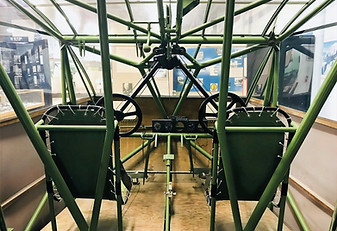
WACO CG-4 Combat Glider Cockpit
TUSKEGEE AIRMEN
Lt. Col. James C. Warren, USAF (Ret.), who began his career as one of the original Tuskegee Airmen, created this comprehensive exhibit. He enlisted in the U.S. Army Air Forces in November, 1942 and retired with the rank of Lt. Colonel in 1978. He served in WWII in the 477th Bombardment Group (medium) and flew more than 173 combat missions, including the Korean and Vietnam Wars.
Awards include the DFC with 2 Oak Leaf Clusters, Air Medal with 11 Oak Leaf Clusters, 3 Meritorious Service Medals, and Air Force Commendation Medal. He is the author of Tuskegee Mutiny at Freeman Field. James Warren passed away on May 17, 2014, at the age of 90.

Lt. Col. James C. Warren
The Tuskegee Airmen was the popular name given to a group of African American pilots who flew with distinction for the United States Army Air Forces during World War II. Before and during the war, the U.S. armed forces—like much of American society—were segregated by race. As a result, most African American service members were assigned to support roles rather than combat positions and had limited opportunities for advancement or command.
In 1940, responding to pressure from prominent African American leaders such as A. Philip Randolph and Walter White, President Franklin D. Roosevelt authorized the U.S. Army Air Corps (renamed the U.S. Army Air Forces in 1941) to accept Black volunteers for pilot training.
The first all-Black flying unit, the 99th Fighter Squadron, trained at Tuskegee Army Air Field in Alabama—giving rise to the collective name “Tuskegee Airmen” for the Army’s African American aviators. Under the leadership of Colonel Benjamin O. Davis Jr., the first African American officer to solo an Army aircraft, the 99th Fighter Squadron entered combat in North Africa and Italy in 1943.

Tuskegee Airmen Exhibit

Colonel Benjamin O. Davis, Jr.-
The first African-American to fly solo as an officer
In 1944, the 99th was joined with three additional African American squadrons to form the 332nd Fighter Group, whose pilots earned an outstanding combat record and helped pave the way for the eventual desegregation of the U.S. military.
"FAT MAN" NUCLEAR BOMB
The “Fat Man” atomic bomb was dropped on Nagasaki, Japan, on August 9, 1945, near the end of World War II. The weapon was released by the B-29 Superfortress Bockscar, which is on display today in the U.S. Air Force Museum’s Air Power Gallery.
Weighing approximately 10,000 pounds, Fat Man detonated at an altitude of about 1,800 feet above the city. The explosion produced a yield equiva-

“Fat Man” Nuclear Bomb
lent to roughly 20,000 tons of TNT, comparable to the atomic bomb dropped on Hiroshima three days earlier. However, due to Nagasaki’s hilly terrain, the overall damage was less extensive than in the relatively flat city of Hiroshima.
Fat Man was an implosion-type nuclear weapon that used plutonium as its fissile material. A subcritical plutonium core was placed at the center of a hollow sphere of high explosive. When multiple detonators surrounding the explosive were fired simultaneously, they created a powerful inward pressure that compressed the plutonium, increasing its density. This compression produced a supercritical state, resulting in a nuclear explosion.